
Madagascar is entering a new phase of economic consolidation and opportunity. Despite a global landscape shaped by geopolitical, social and economical tensions, the country has demonstrated a resilience that sets it apart in the region. Its macroeconomic fundamentals remain solid, underpinned by prudent management, structural reforms, and a commitment to transparency, elements that are increasingly resonating with international investors.
Economic growth has averaged around 4% since the Covid-19 crisis, outperforming Sub-Saharan Africa and confirming the country’s recovery trajectory. While structural vulnerabilities persist, particularly regarding climate shocks and infrastructure gaps, measures taken in recent years have helped maintain stability. Inflation has been kept under control thanks to proactive monetary action, and reforms in public finance administration, especially digitalization efforts, have improved the efficiency of revenue collection and public expenditure. These reforms contribute to a more predictable business environment, a crucial factor for unlocking long-term investment flows.
Madagascar is currently implementing an economic program supported by the IMF through the Extended Credit Facility (ECF) and the Resilience and Sustainability Facility (RSF). All macroeconomic indicators are reviewed every six months, and the recent approval of the program’s second review, which unlocked approximately USD 107 million, demonstrates progress in key areas such as revenue mobilization, primary balance management, and debt sustainability. Although the country continues to navigate a challenging global environment, this endorsement strengthens investor confidence and confirms that the reform agenda is moving in the right direction.
In recent years, significant efforts have been made to modernize revenue administration and public financial management. Tools such as eComptabilité, e-Hetra, and the Integrated Tax Administration System (SAFI) are helping reduce human error, enhance transparency, and limit informality. On the expenditure side, instruments like the Annual Commitment and Mandatement Plan (PAEM), updated treasury management frameworks, and new digital platforms for monitoring external financing and non-fiscal revenues have contributed to better planning and oversight. These initiatives increase the credibility of public financial management and ultimately support a more conducive climate for private-sector activity.
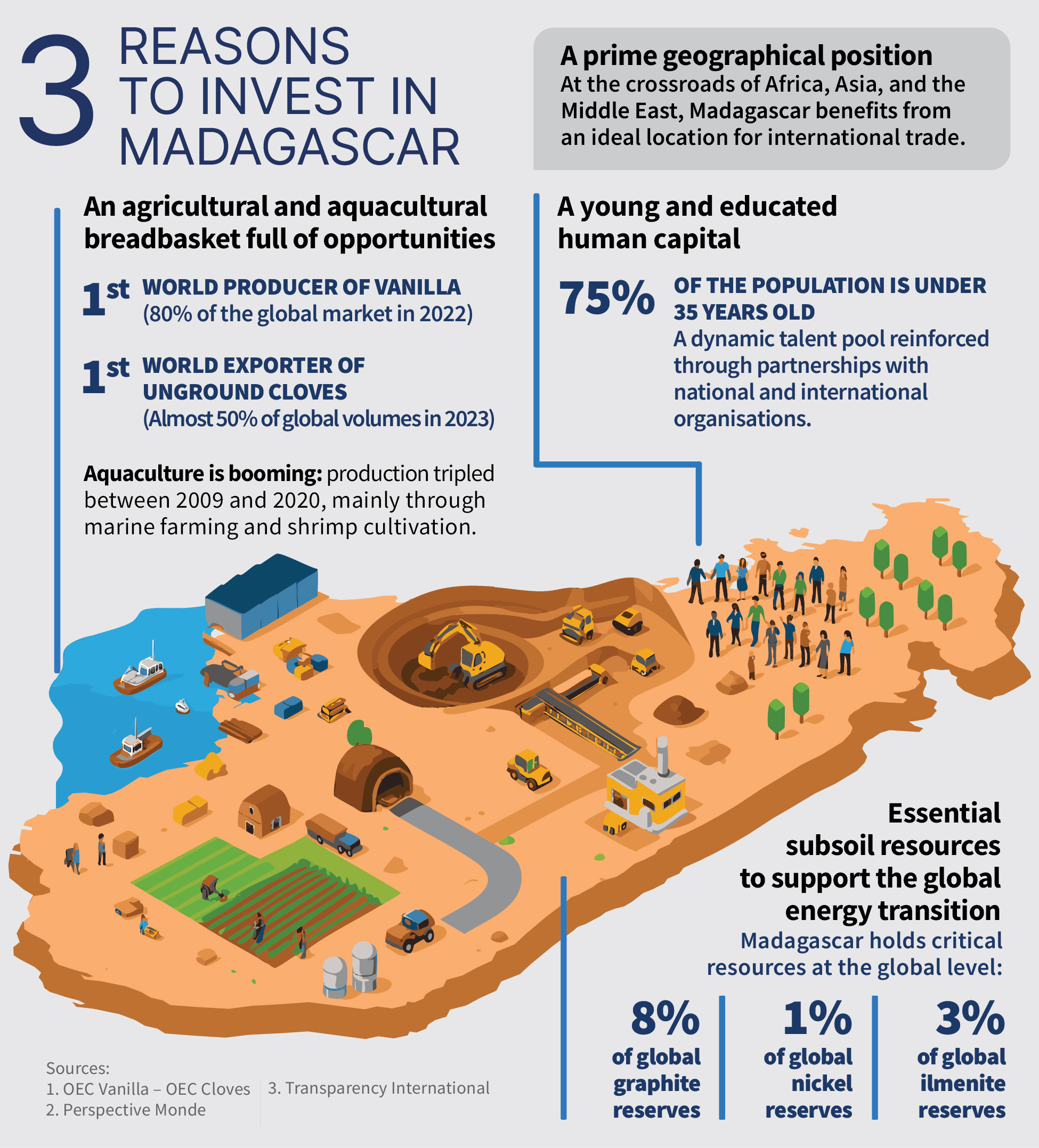
Madagascar’s economic potential is vast and diverse. Its natural resource base, fertile land, unique biodiversity, blue economy potential, and significant mineral reserves, forms a strong foundation for high-return investments. But the opportunity landscape extends far beyond natural assets. The country’s strategic location allows companies to serve Europe in real time and the United States on a near overnight cycle, positioning Madagascar as an emerging hub for digital services, telecommunications, and business process outsourcing.
The expansion of the Port of Toamasina, expected to be completed in 2026, is another major step toward enhancing the country’s role as a regional logistics gateway. Similarly, a young and increasingly skilled workforce is supporting the growth of sectors such as information technology, artificial intelligence, agribusiness, light manufacturing, and renewable energy.
Public-private partnerships (PPP) are gaining relevance as the country seeks to expand energy, transport, and social infrastructure despite budget constraints. Projects such as the Sahofika and Volobe hydroelectric plants illustrate this approach, with private-sector participation representing a significant share of total financing. Madagascar is also in the process of modernizing its PPP legal framework, which should provide greater clarity and predictability for future investors. Opportunities also exist in transport connectivity, special economic zones, and logistics corridors.
Financing development remains a central challenge, and the country is actively diversifying its resource mobilization strategy. Increasing domestic revenues through digitalized tax administration, broadening the tax base, and rationalizing exemptions are key priorities. At the same time, Madagascar is expanding its engagement with international finance through blended finance instruments, equity participation from institutions such as IFC and Africa50, and risk-mitigation guarantees from agencies like MIGA. Climate finance will also play a growing role, with green bonds, blue bonds, and other thematic instruments under consideration.
Recent years have seen renewed interest from international investors across a variety of sectors. Strategic projects, including the Volobe hydropower development and the USD 700 million Base Toliara mining project, illustrate both rising appetite and the country’s improved investment environment. While challenges remain, the foundation for sustained private-sector engagement is stronger than at any point in recent history.
Madagascar is ready to welcome a new generation of strategic investments, and crucially, it is taking concrete steps to ensure that these investments can be absorbed effectively. With ongoing reforms, a favorable geographic position, a young workforce, and an increasingly modernized business environment, the country is positioned as an emerging gateway to the Indian Ocean and a destination with real, long-term potential for investors seeking both impact and opportunity.


