
There are cruise ships that deliver passengers to paradise, and then there is Aranui, a company that has spent more than four decades proving that the vessel itself can be the point. Since 1984, when a Tahitian cargo company called Compagnie Polynesienne de Transport Maritime converted its freighter to carry passengers alongside provisions, Aranui Cruises has been threading through some of the most isolated waters on earth. The ships don't pull into sanitized terminals. They drop anchor where communities need them most, unloading rice, cement, and school supplies while travelers stand at the rail, watching a logistical lifeline perform its work in real time. That spectacle, unglamorous, essential, quietly theatrical, is as much a part of the experience as any beach landing.
.jpg)
The Aranui 5: Living Alongside the Marquesas
The Marquesas Islands are not postcard Polynesia. There are no sprawling lagoons, no resort beaches smoothed for tourism. What they offer instead is something rawer and richer: towering basalt cliffs, valleys muffled in jungle, a living artistic tradition stretching back centuries. The Aranui 5 has served this archipelago as freighter, lifeline, and floating cultural ambassador for decades, and the ship's identity is inseparable from the islands it connects.
The nearly all-Polynesian crew shapes the onboard world accordingly, filling evenings with traditional music and dance, building menus around fresh fish and produce sourced directly from island communities. A Marquesan tattoo artist keeps a studio aboard, crafting ancestral designs that map each traveler's personal story onto their skin, one of several initiatives that dissolve the boundary between visiting a place and genuinely inhabiting it. Guest lecturers, painting workshops inspired by the surrounding landscapes, and onshore dinners prepared by local families complete a program oriented entirely around the islands rather than the ship.
Accommodating up to 254 passengers across 103 cabins, from Presidential Suites with expansive private balconies to four-berth family staterooms, the Aranui 5 runs a thirteen-day itinerary through the Marquesas, Society Islands, and Tuamotu. It calls at Nuku Hiva, where stone platforms and petroglyphs survive in the jungle above Taiohae Bay; at Fatu Hiva, the most remote island in all of French Polynesia; and at Ua Pou, whose cathedral basalt spires frame one of the Pacific's most dramatic harbors. At each port, the cargo operations themselves become part of the spectacle, a choreography of cranes, skiffs, and crew that locals and passengers gather around together, the line between observer and participant blurring naturally.
Aranui has long called itself the "seventh island" of the Marquesas, a phrase that earns its weight. Over four decades, the ship has helped convert subsistence fishermen and farmers into guides, drivers, and artisans, keeping tourism revenue circulating within the communities it visits. Goods flow outward from Tahiti; economic opportunity flows inward. It is, by design, a circular economy carried on a hull.
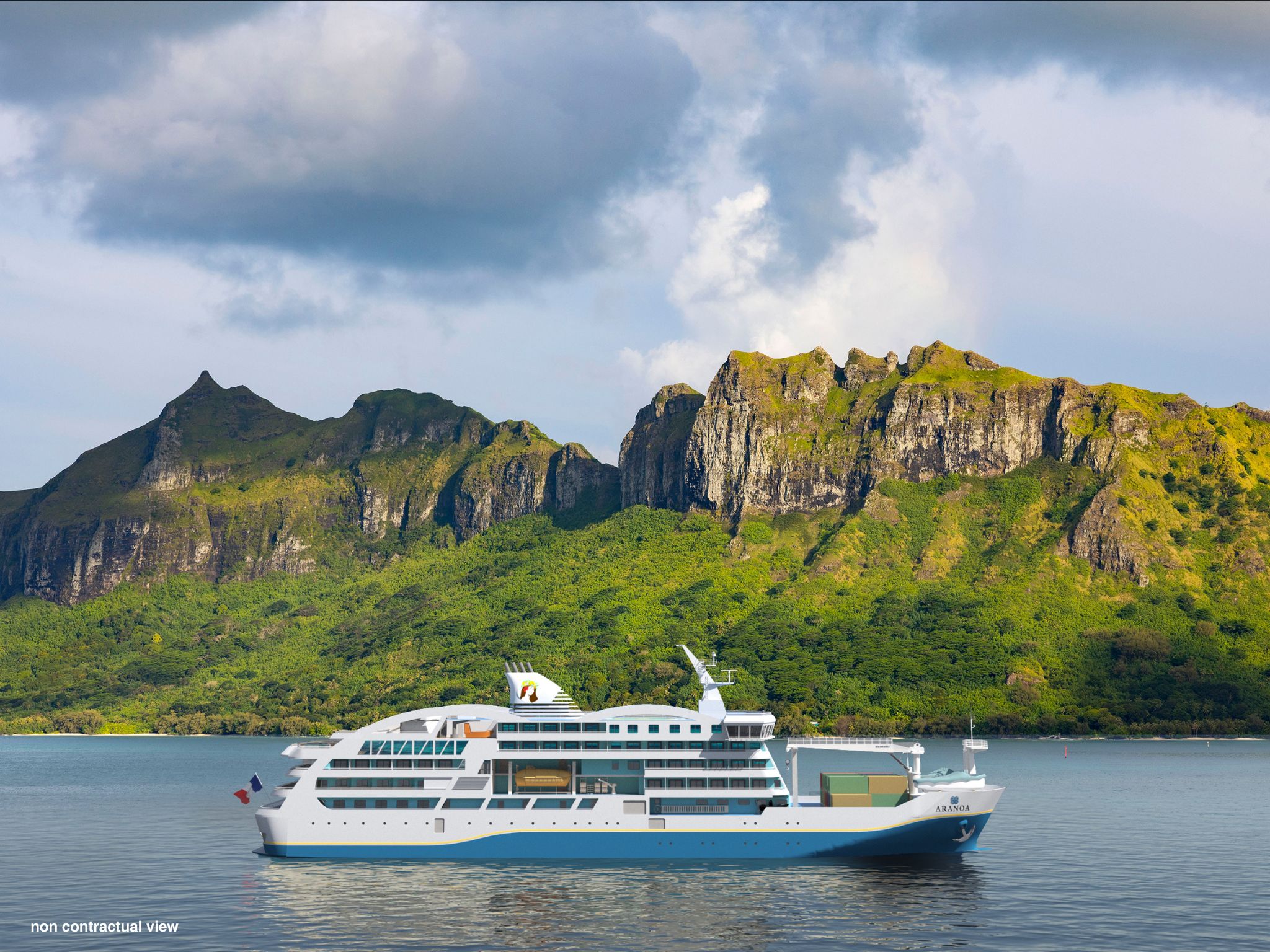
The Aranoa: A New Ship for an Undiscovered Polynesia
Launching in 2027, the Aranoa is Aranui's next proposition, and its most ambitious. Where the Aranui 5 has long anchored itself to the Marquesas, the new vessel will chart a course through the Austral Islands, an archipelago located roughly 300 miles south of Tahiti that most of the world has yet to find. Picture Bora Bora half a century before tourism arrived: lush volcanic mountains falling into lagoons of startling color, communities whose warmth is unhurried and unperformed precisely because outside visitors remain rare.
The five inhabited islands of the Australs, Rimatara, Rurutu, Tubuai, Raivavae, and Rapa, each carry their own character. Raivavae is ringed by a reef of extraordinary beauty. Rurutu is known for humpback whale gatherings offshore. And Rapa, the southernmost and perhaps the most arresting of the five, is governed entirely by a council of elders who manage all land as communal property. To preserve its cultural traditions, the Aranoa will be permitted to call there just six times per year, the kind of access that cannot be engineered or scaled, and that defines the entire spirit of the itinerary.
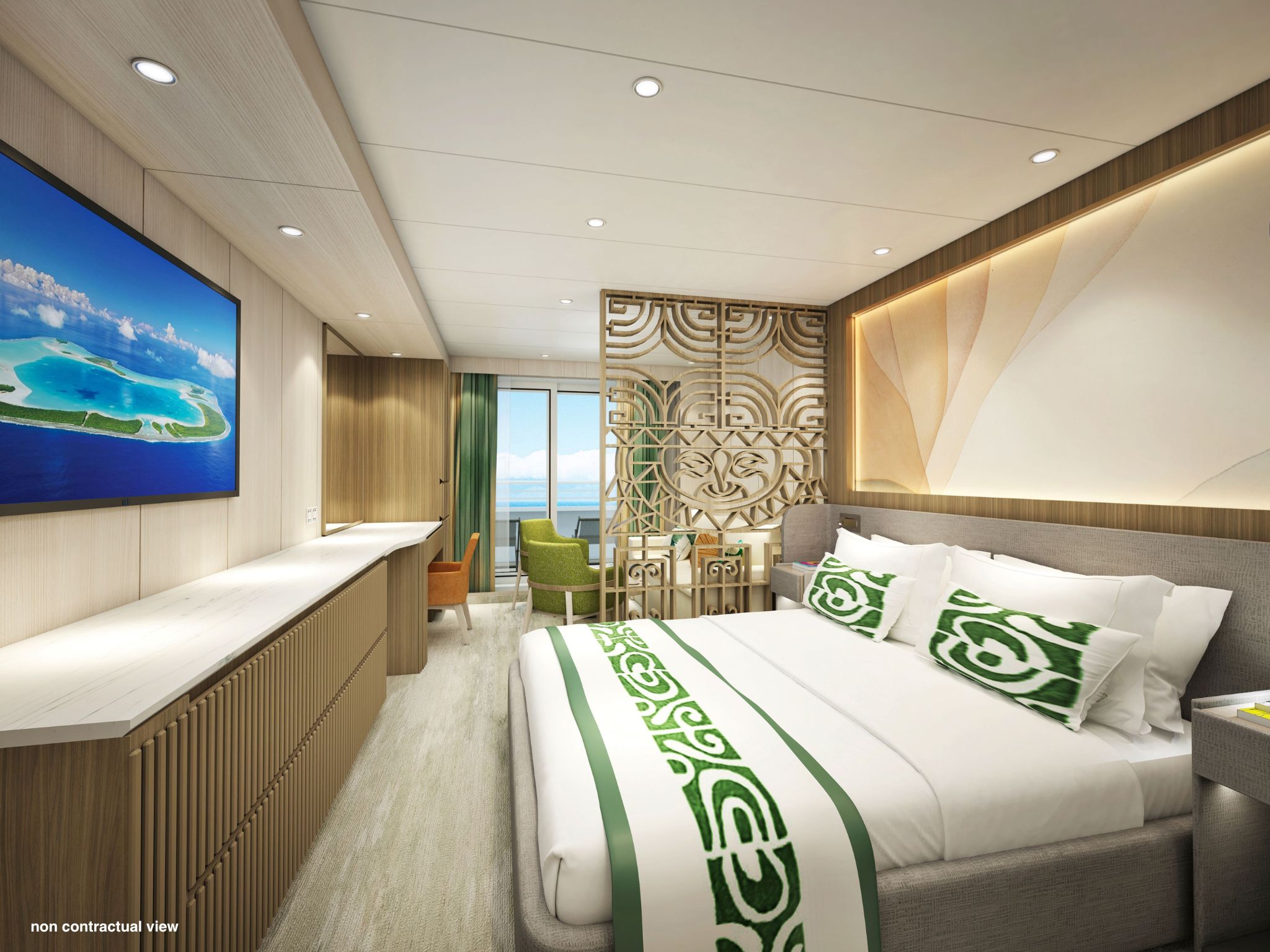
The vessel itself reflects a philosophy of deliberate refinement. Custom-built with more than forty years of Aranui know-how behind it, the Aranoa will carry 198 passengers across 91 cabins, 62 of which feature private balconies. Two restaurants, two bars, a spa and fitness room, a lounge, a boutique, and two whirlpools complete the public spaces. At 380 feet with a crew of 103, it is engineered for smooth passage through remote waters. A diesel-electric propulsion system, ecofriendly antifouling hull coating, and dynamic positioning technology reduce fuel consumption and environmental footprint, a design priority that reflects Aranui's commitment to sailing responsibly through landscapes that remain, against considerable odds, largely pristine.
Beyond its regular year-round Austral itinerary, the Aranoa will make occasional extended voyages through the eastern Tuamotu atolls and the Gambier Islands, ending at Pitcairn, one of the most isolated inhabited islands on the planet. And for travelers or organizations seeking an entirely exclusive passage, the Aranoa is available for private charter. Whether for a corporate retreat, a cultural expedition, a film production, or a multigenerational family voyage in search of something genuinely unrepeatable, chartering the full vessel offers complete flexibility over itinerary, programming, and pace, in waters that no other ship currently reaches.
The Marquesas earned their UNESCO recognition slowly, through decades of quiet stewardship. The Australs are at the beginning of that story. Aranui intends to be there for it, and to bring along anyone curious enough to make the crossing.


