
Mauritius is sharpening its value proposition as an International Financial Centre (IFC) at a moment when global finance is being reshaped by technology, geopolitics and higher expectations on transparency. At the centre of this effort is a joined-up approach that links long-term economic planning with a modernised financial services agenda, positioning the island as a stable bridge between Africa, Asia and the Gulf.
Jyoti Jeetun, Minister of Financial Services & Economic Planning, says the ministry’s remit is deliberately dual. “Our ministry brings together two important portfolios: financial services and economic planning.” After nearly two decades, economic planning has been re-established with a mandate to develop Vision 2050, “a long-term strategy that sets out Mauritius’ growth pillars for the next 25 years”. The objective is not to discard traditional strengths, but to decide “what comes next” amid “technological disruption, shifting trade patterns, and geopolitical developments”, alongside domestic pressures such as “an ageing population, a shrinking workforce, climate change, and sustainability concerns”.

Vision 2050 is being developed as an inclusive process involving collaboration across government and with stakeholders from the economic, social and environmental spheres. It will be supported by a 10-year National Development Framework designed to translate long-term vision into concrete, actionable priorities guiding investment decisions and skills development.
Financial services already sits at the heart of the Mauritian economy. Based on the Government’s Strategy Report 2025–2030, the financial services sector contributed about 13.4% of GDP in 2024 and remains a key gateway connecting Africa and Asia. The document underlines the sector’s scale, including direct employment of 19,745 professionals and Mauritius’ 52nd position in the September 2025 Global Financial Centres Index (GFCI).
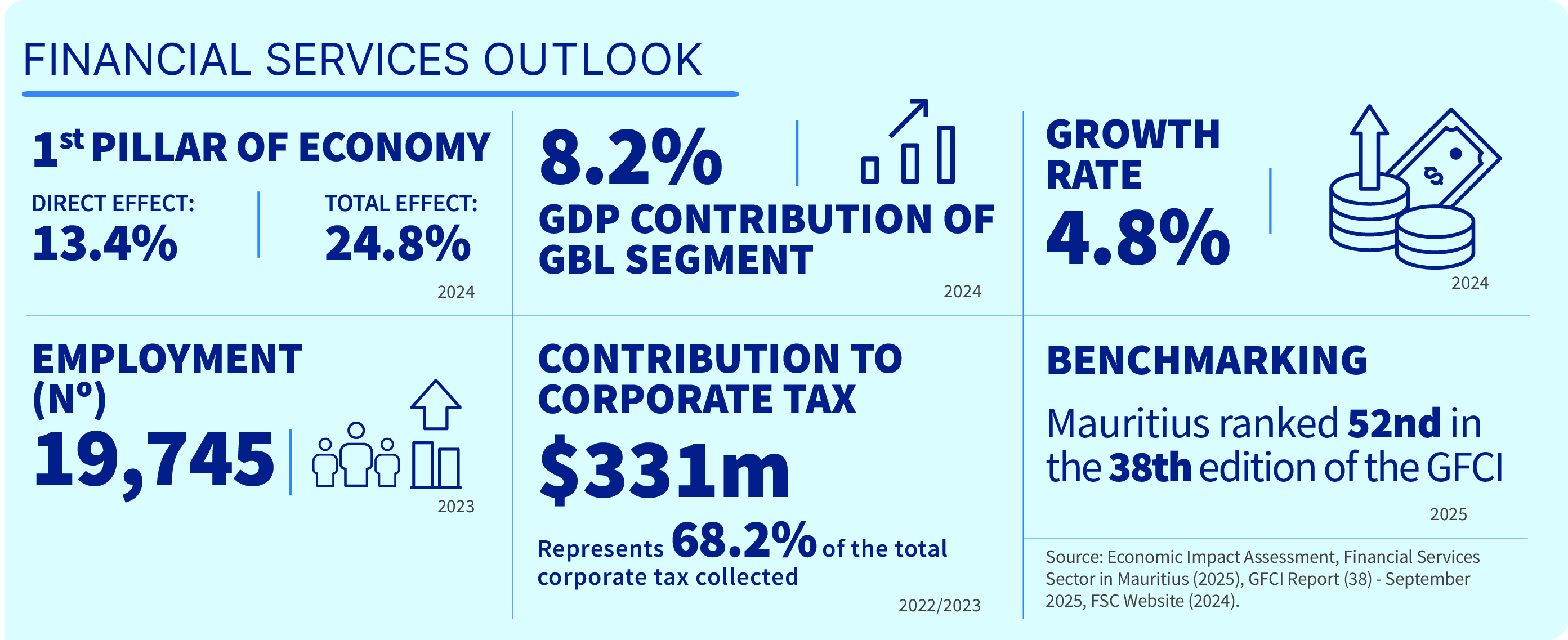
Against this backdrop, Jeetun says the new government has moved quickly. “One of our first actions was to develop a five-year financial services strategy covering 2025 to 2030.” The strategy is built around five pillars: improving ease of doing business, reducing the cost of doing business, diversifying products and markets, strengthening promotion and international visibility, and addressing skills shortages, backed by “ambitious but achievable targets for 2030”.
For Mauritius, credibility is non-negotiable. “Trust is the foundation of any international financial centre,” Jeetun stresses, pointing to continual upgrades to anti-money laundering and counter-financing of terrorism (AML/CFT) legislation in line with evolving FATF recommendations, ahead of a 2027 mutual evaluation. She adds that Mauritius is “determined to avoid any risk of Mauritius being perceived as a tax haven or being placed on any monitoring lists.” Reforms are also focused on making regulation more efficient through digitalisation, including e-KYC and streamlined licensing.
That balance, strict compliance combined with pro-growth regulation, is echoed by Désiré Vencatachellum, CEO of the Financial Services Commission (FSC). “We see ourselves as a compliant but enabling regulator. Compliance is non-negotiable, but at the same time, regulation must enable growth.” He highlights tools such as the regulatory sandbox for fintech and green finance and is clear that “we never compromise on regulation, compliance, or AML/CFT standards.”

Sustainability is also moving from aspiration to product. Jeetun says, “Sustainability is being embedded directly into our financial ecosystem,” citing ESG guidelines and work on sustainable bonds, positioning Mauritius as a stable jurisdiction for structuring capital deployed into Africa.
Looking to Gulf readers, the message is direct. With strong air connectivity and growing high-level engagement, Jeetun frames the invitation simply: “Mauritius is open for business”, as a platform built on political stability, strong institutions and a rules-based ecosystem designed to earn and keep investor trust, offering long-term certainty for international investors and institutions seeking access to emerging markets across Africa and the Indian Ocean region.
The strategy reinforces Mauritius’ ambition to serve investors with clarity, predictability, regional connectivity, innovation, resilience, scale, and long-term confidence globally.


