
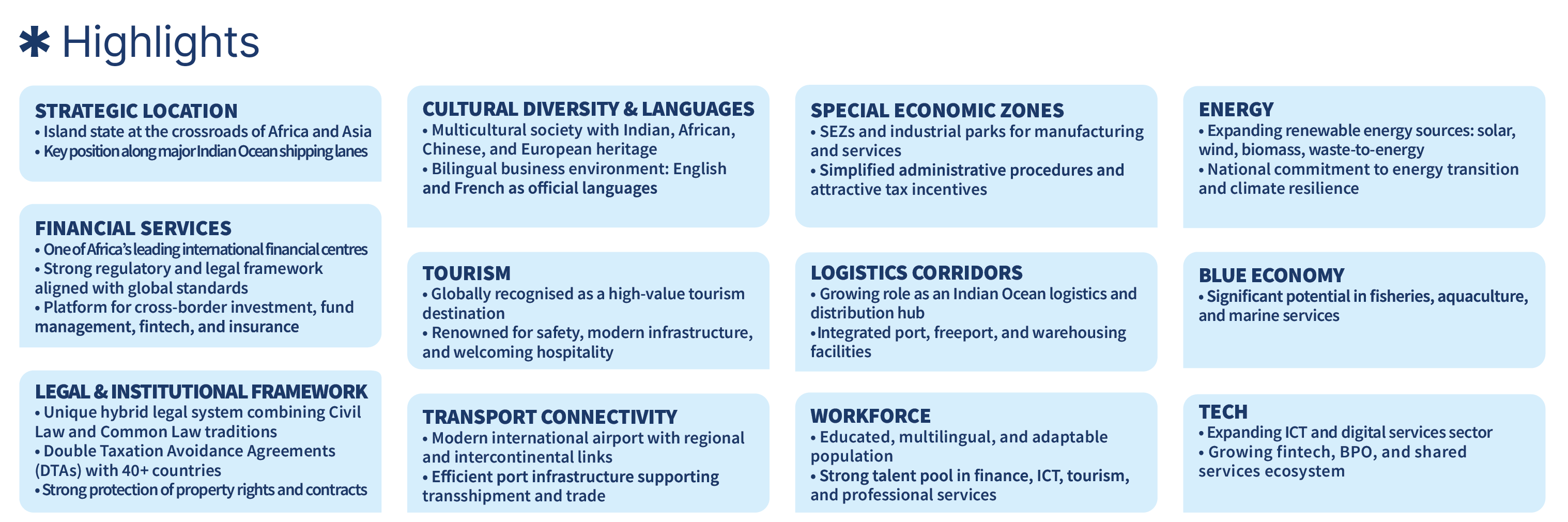
Mauritius has evolved from a monocrop sugar economy into one of the Indian Ocean’s most diversified and resilient nations, combining political stability, openness and economic sophistication. Today, the island’s attractiveness lies in its ability to bridge Africa, Asia and the Middle East while offering investors a predictable and business-friendly environment.
According to Ritish Ramful, Minister of Foreign Affairs, Regional Integration and Trade, geography remains a core strength. “Our strategic geographic location, at the crossroads of Africa, the Middle East and Asia, positions us as a gateway for investment into Africa.” Membership in regional blocs such as SADC, the African Continental Free Trade Area, the Indian Ocean Commission and the Indian Ocean Rim Association reinforces Mauritius’ diplomatic reach and trade integration. Trade agreements now cover around 70% of the world’s population, including key partnerships with India, China and the UAE.
.jpg)
This international openness supports a diversified economic base. Beyond tourism and financial services, Mauritius is expanding into the blue economy, renewable energy, artificial intelligence, biotechnology and pharmaceuticals. The country is also positioning itself as a regional education hub, supported by strong institutions and constitutional guarantees that enhance investor confidence. As Ramful notes, “Mauritius remains a trusted, stable, and open partner, ready to collaborate with the UAE and the wider Middle East.”
Commerce and consumer protection policies further strengthen this attractiveness. Michaël Yeung Sik Yuen, Minister of Commerce and Consumer Protection, underlines the importance of stability and efficiency. “Security is vital, without it, there can be no business.” Ranked among Africa’s safest countries, Mauritius offers modern infrastructure, improving logistics and a responsive public administration. Close cooperation with the Economic Development Board helps local and foreign investors navigate regulations, while reforms such as a new Consumer Protection Bill aim to modernise e-commerce and ensure fair digital trade.

Agro-industry and the blue economy are equally central to long-term resilience. Arvin Boolell, Minister of Agro-Industry, Food Security, Blue Economy and Fisheries, recalls how diversification became a national strategy. “We used the proceeds from sugar exports to diversify and create new pillars for our economy.” Today, Mauritius is investing in smart agriculture, aquaculture and value-added agro-processing to strengthen food security and sustainability.

From democratic governance to sectoral diversity, Mauritius presents a compelling proposition. As Boolell concludes, “Mauritius is a country on the rise,” offering Gulf and international partners a stable gateway into Africa and beyond.


