
1. Can you take us back to the origins of Coral Gardeners? How did a youth-led initiative in Moorea grow into a globally recognized movement for ocean conservation?
I actually spent the first four years of my life in the remote atolls of the Tuamotu Archipelago. My parents had a pearl farm, so I was the only kid there. It was completely remote, just corals, fish, sharks all around. That was my playground. That environment really shaped me.
Then, when I turned four, I had to go to school, so we moved to Moorea, which is where Coral Gardeners is now based. Growing up there was magical. With my childhood friends, we spent all our time in the ocean, surfing, spearfishing, freediving, climbing trees. The ocean was not something we visited, it was our life.
When I was 16, everything changed. I was surfing one of my favorite reef break, and I remember that day clearly, the corals had turned completely white. The reef had lost all its colors. I had never seen anything like that before.
At the time, I did not even know corals were alive, I thought they were rocks. But when I got home and started researching, I realized what bleaching meant. I realized we were losing coral reefs, one of the most important ecosystems on Earth.
That hit me hard. Because suddenly I understood that everything in my life was connected to coral reefs. The waves we surf, the fish we eat, the tourism, even the oxygen we breathe, so much of it depends on healthy oceans.
And I learned that we had already lost 25 percent of the world's coral reefs.
I looked around me and thought, why is no one doing anything? Moorea is one of the most studied coral reef ecosystems in the world, with institutions like the University of California, Berkeley and French research labs present. There was knowledge, but not enough action.
Then, just a few weeks later, I was introduced to coral restoration, coral gardening. And I fell in love with it instantly. It felt like being an underwater artist, growing these tiny corals, bringing life and color back. Fish became your co-workers. Sharks, stingrays, you are in your own world.
At 18, I dropped out of university in France, came back to Moorea, gathered my friends, and told them, if we work hard enough, one day we will create a new job, being paid to regenerate coral reefs.
They said, maybe, but let us just start by saving the reef.
That is how Coral Gardeners began.
2. How urgent is the situation facing coral reefs today, both in French Polynesia and globally? What are the biggest threats?
I do not think people truly understand what is happening underwater.
We talk about fires on land, but the biggest fire is in the ocean. The ocean is heating up. It is boiling.
Right now, as we are speaking in March 2026, the water temperature is rising again, and corals are starting to bleach.
When I started Coral Gardeners nine years ago, about 25 percent of coral reefs were gone. Today, it is around 50 percent.
And scientists are clear, if nothing changes, by 2050, we could lose up to 90 percent of coral reefs.
The main causes are climate change, rising ocean temperatures, and acidification. The stress events are happening too frequently for reefs to recover.
And the tragedy is, we cannot afford to lose them.
Coral reefs are among the most biodiverse ecosystems on Earth. Even more than rainforests. Places like Raja Ampat hold incredible biodiversity.
They are also essential for food security, coastal protection, and even medicine. We are potentially losing future cures for diseases as reefs disappear.
In Polynesian culture, corals are deeply symbolic. In the Kumulipo, the Hawaiian creation chant, coral polyps represent the first form of life. Everything else follows.
These ecosystems have existed for over 400 million years. And in just a few decades, we have destroyed half of them.
That said, there is still hope. French Polynesia has some of the most resilient reefs in the world. If we act now, we can still protect and restore them.
3. Coral Gardeners is known for its innovative restoration techniques. How does coral farming and transplantation work in practice?
At the beginning, we did not know much. We were just kids experimenting.
But over time, we brought in top scientists from around the world, including experts from organizations like The Nature Conservancy.
We built a methodology that combines science, local knowledge, and innovation.
The process has three main steps.
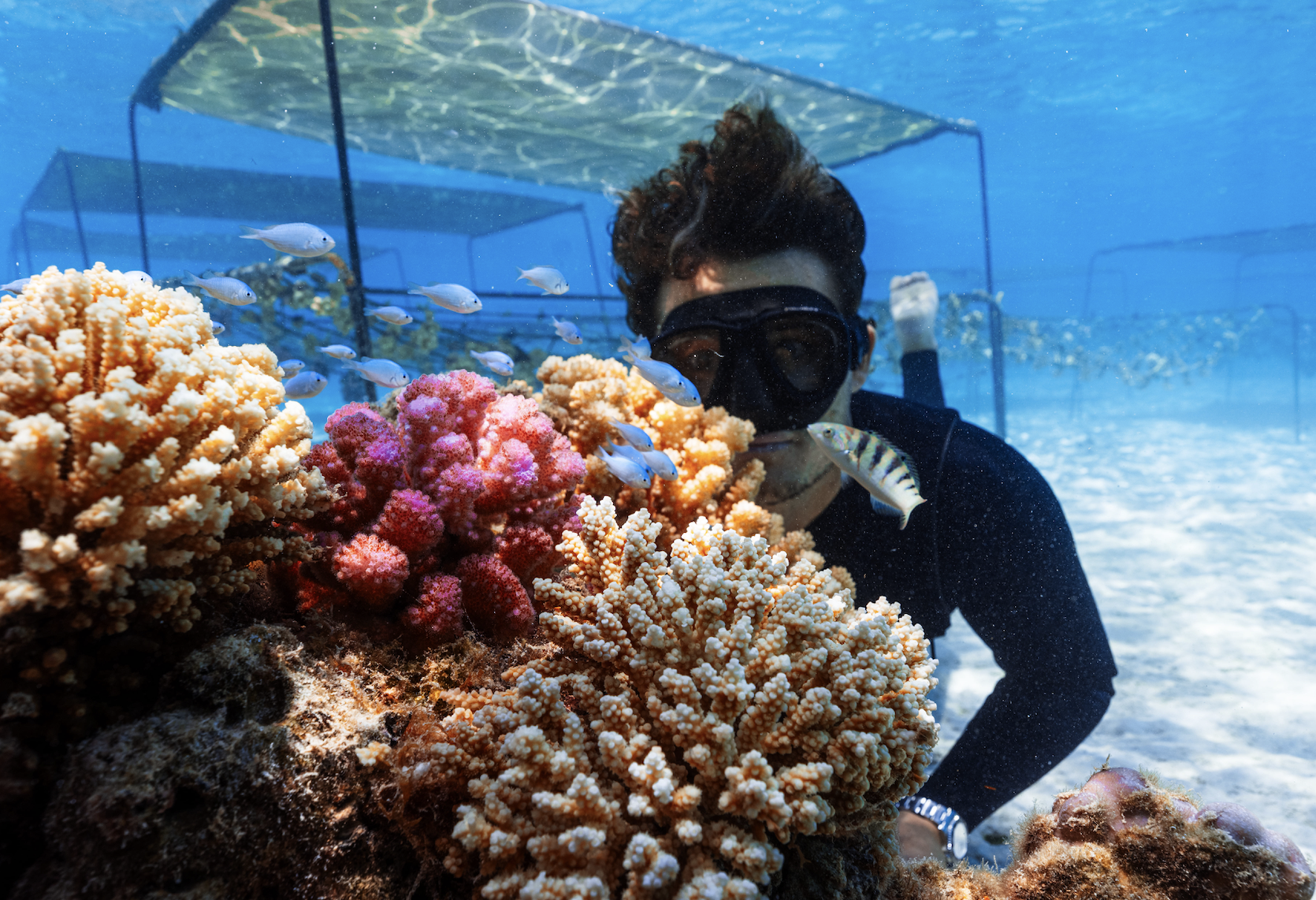
First, we identify resilient super-corals, colonies that survived bleaching events. These become our donors.
Second, we take small fragments and grow them in underwater nurseries for about one and a half to two years. It is intensive work, cleaning, monitoring, protecting them.
Then, once they are mature, we transplant them onto degraded reefs.
When done at scale, the results are incredible. In one site, after planting 20,000 corals, we doubled the fish population in just 13 months.
It is hard work, but it works.
4. You have also integrated cutting-edge technology. How are you leveraging innovation and data?
This is one of the things that makes Coral Gardeners unique.
About six years ago, I met Drew Gray, a former engineer from Tesla and Uber. He left Silicon Valley to help save the ocean.
Together, we built Coral Gardeners Labs, our research and development center.
With support from tech leaders like Larry Page, we hired engineers from Google, Microsoft, and SpaceX.
We developed artificial intelligence tools that allow us to monitor reefs in real time, tracking temperature, biodiversity, fish populations.
We even use iPhones underwater to scan corals, collect data, and translate it into local languages, making science accessible to local communities.
For the first time, technology is empowering local fishermen and surfers to become scientists.
5. Coral Gardeners blends science, community, and storytelling. How do you balance these elements?
Early on, I realized that coral reef loss is a global problem, so we needed a global audience.
I studied brands like Nike and Apple, how they use storytelling to build movements.
We applied that to conservation.
Because the truth is, traditional conservation can feel slow and disconnected. We wanted to make it exciting, emotional, and human.
We focus on the people, the gardeners, their stories. That’s what connects.
It worked. We grew a community of 1 million followers online. Celebrities like Jason Momoa, Lewis Hamilton and Benedict Cumberbatch got involved. Organizations like National Geographic partnered with us.
Storytelling turned a local initiative into a global movement.
6. You’ve partnered with major global brands and institutions. What do these collaborations bring?
They’re essential, but we’re very selective.
We’ve partnered with brands like Rolex and Prada, not just for funding, but for credibility and visibility.
We now have 85 full-time team members and have raised over $20 million.
These partnerships act as accelerators. But they have to align with our values.
7. How do you inspire the next generation to take action?
We show them that it’s possible to have a career that combines purpose, fun, and impact.
We’ve received hundreds of thousands of job applications.
We also run education programs across schools in Tahiti and Moorea, teaching kids how to grow corals, monitor reefs, and understand their ecosystem.
This is about creating the next generation of ocean stewards.
8. What role can tourism play in conservation?
Tourism can either destroy, or regenerate.
We believe in regenerative tourism.


