
1. How would you describe Project Hostos and the vision that inspired you to develop the Caribbean’s first cross-border energy interconnection?
I believe that electricity interconnection is becoming increasingly common across Europe and Asia. Central America is interconnected, as is South America, and there are 164 electricity interconnections involving Canada, the United States and Mexico. It is therefore only natural that we should address the Caribbean’s geographical fragmentation by connecting the region’s islands through shared energy infrastructure.
The idea is not new; it dates back to the 1980s. Hillary Clinton also proposed interconnecting the Caribbean, initially considering a link between Puerto Rico and the US Virgin Islands because both are American territories. However, this approach presented two major challenges. First, connecting two American jurisdictions would bring both under the regulation of the Federal Energy Regulatory Commission (FERC). Second, their electricity demands differ considerably: Puerto Rico has a peak demand of approximately 3,200 megawatts, compared with just 60 megawatts in the US Virgin Islands.
We believe the best starting point is to connect the Caribbean’s two largest economies: the Dominican Republic and Puerto Rico. They have more comparable energy consumption profiles, making them a natural foundation for regional integration. We see this initial connection as the trunk of a larger network, from which additional connections can eventually branch out across the Caribbean.
2. Project Hostos represents a US$2.5 billion private investment to generate electricity in the Dominican Republic and export it to Puerto Rico. What makes it the region’s first cross-border energy infrastructure project, and why is it so significant?
Countries around the world are increasingly interconnected through electricity networks. Telecommunications provide a useful comparison: the world is now connected through communications infrastructure, yet the first submarine telecommunications cable was laid approximately 100 years before the first submarine electricity cable.
We believe that, within the next century, the world will also become interconnected through electricity networks. Puerto Rico and the Dominican Republic have the potential to become the Caribbean’s hub for this integration.
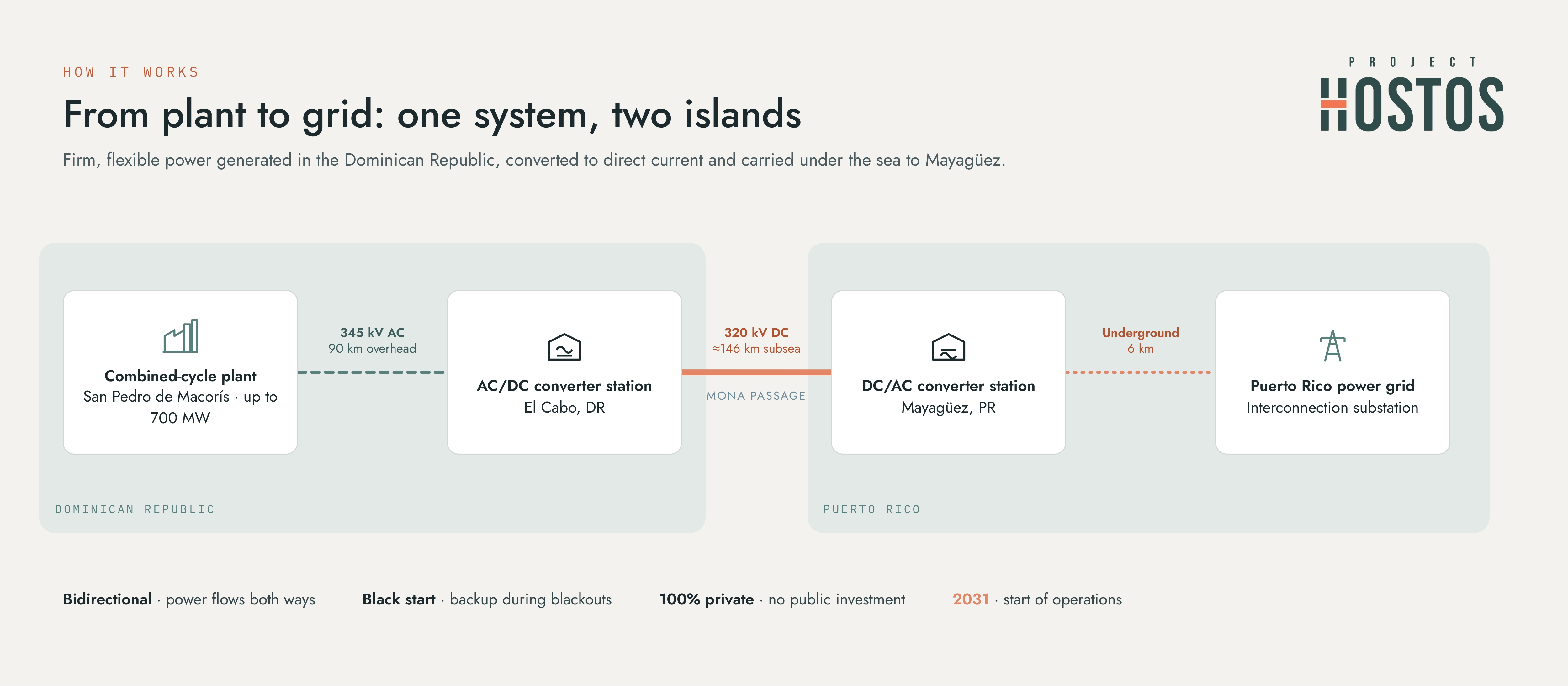
Hostos represents an investment of US$2.5 billion, with electricity generated in the Dominican Republic and transmitted to Puerto Rico. The infrastructure is also designed to allow both countries to exchange electricity according to their respective needs. To realise this potential fully, however, both countries will need appropriate regulatory frameworks governing electricity imports and exports.
3. The project includes a gas-fired combined-cycle power plant in San Pedro de Macorís. How much electricity will it generate, and what proportion of Puerto Rico’s energy demand could it meet?
The plant will generate 675 megawatts in San Pedro de Macorís, with 645 megawatts delivered to Puerto Rico after accounting for transmission losses. This represents almost 20% of Puerto Rico’s electricity demand, serving a population of approximately 3.2 million people.

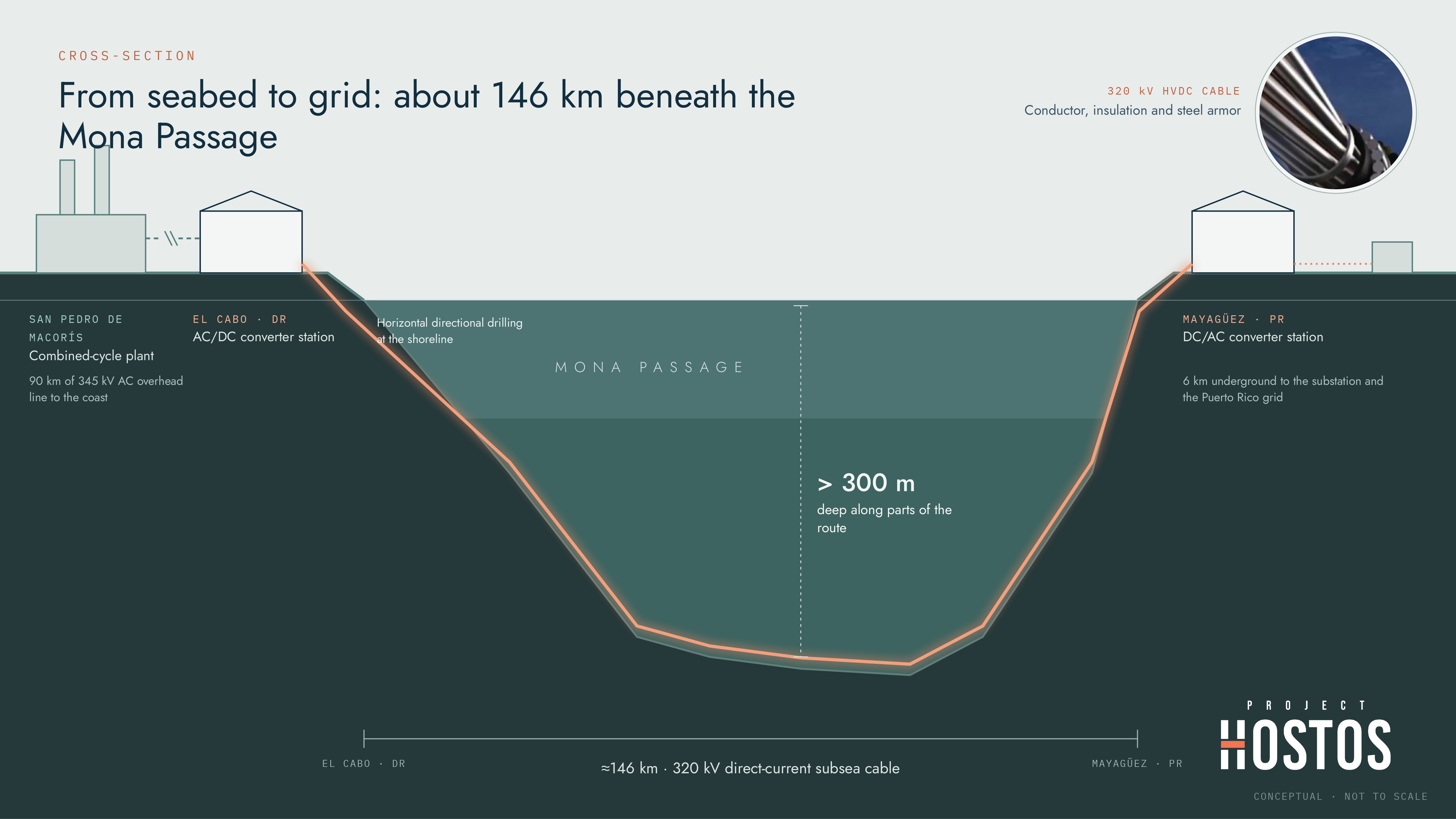
4. At the technical heart of Project Hostos is a 150-kilometre high-voltage direct-current (HVDC) submarine cable crossing the Mona Passage. What engineering challenges does connecting the two islands present, and how will they be addressed?
We do not consider the seabed depth to represent a major engineering challenge. We have designed a specific route that takes into account protected areas, anchorage zones, fishing areas, seabed gradients and water depths. The average depth is approximately 136 metres, while the maximum depth is around 500 metres. In the submarine cable industry, these conditions are generally considered relatively shallow waters.
I would say that the greatest challenge is regulatory rather than technical. Both countries have historically operated in isolation and managed their own electricity generation systems. Establishing the regulatory framework for exchanging electricity across the border will therefore be the more significant challenge.
There is also an economic advantage to consider. The natural gas consumed in the Dominican Republic is sourced from the United States. Puerto Rico, however, faces restrictions under the Jones Act cabotage regime that make it more difficult to receive American natural gas, leading it to purchase supplies from Trinidad and Tobago, Qatar and other countries. As a result, fuel in Puerto Rico tends to be approximately 15% more expensive than in the Dominican Republic.
5. Puerto Rico faces significant electricity reliability challenges. How will Project Hostos improve the stability, resilience and security of its power grid, while supporting the island’s economic development?
Puerto Rico’s electricity system is integrated and has historically been managed by the Puerto Rico Electric Power Authority (PREPA). The authority filed for bankruptcy in 2016, and Hurricane Maria caused extensive damage to the island’s transmission and distribution infrastructure in 2017.
Approximately US$19 billion in federal funding has been allocated to modernise transmission and distribution. However, there has not been equivalent funding to improve electricity generation. The government has instead focused on encouraging renewable energy.
Puerto Rico currently has approximately 1,600 megawatts of renewable energy capacity, particularly distributed generation. The challenge is that this output cannot be fully controlled: it fluctuates depending on sunlight, cloud cover and other conditions. Meanwhile, the island’s thermal generation units are, on average, approximately 44 years old. They need to be modernised, as they lack the flexibility required to manage the intermittency of renewable energy.
Hostos will introduce a sufficiently flexible generation plant to help manage these fluctuations. It will also provide a crucial backup capability. If Puerto Rico’s electricity system collapses, the generation facility in the Dominican Republic could help restart the island’s grid through a black-start procedure.
Today, restarting Puerto Rico’s electricity system can take between 24 and 36 hours. With Project Hostos, we believe it could be possible to restore the system in approximately 30 minutes. This would represent a major improvement in resilience and energy security.
6. Project Hostos has received a presidential permit from the US Department of Energy and is advancing discussions with Puerto Rico’s Public-Private Partnerships Authority and LUMA Energy. What do these regulatory milestones mean, and what stage has the project reached?
We obtained the presidential permit from the United States in February 2026. This authorisation encompasses the support of the US Department of Energy, the Department of State and the Department of Defense. It is required to authorise infrastructure crossing the US border, including electricity transmission lines, gas pipelines and oil pipelines.
We are currently negotiating with Puerto Rico’s Public-Private Partnerships Authority to establish the power purchase agreement. This contract is necessary to determine the financial arrangements governing the purchase and sale of electricity between Hostos and the Puerto Rico Electric Power Authority.
7. Project Hostos represents a paradigm shift, positioning the Dominican Republic as an electricity exporter. What does this transformation mean for the country, and how could it establish the Dominican Republic as a regional energy hub?
It changes the paradigm entirely. The Dominican Republic becomes an electricity-exporting country and positions itself strategically to become the Caribbean’s energy hub.
The project will effectively double the balance of payments between Puerto Rico and the Dominican Republic, while representing approximately 3% of the foreign currency inflows the Dominican Republic can receive.
The benefits extend beyond the substantial investment itself. Approximately 70% of the US$2.5 billion investment will be directed towards the Dominican Republic. Becoming an electricity exporter will fundamentally change the country’s economic position and create opportunities for further development.
8. Hostos is conceived as a megaproject financed entirely through private capital. How will the US$2.5 billion investment be structured, and what opportunities will it create for investors and strategic partners?
We have conceptualised Project Hostos as a 100% privately financed project. Our intention is to use a project finance structure, with approximately 70% of the project’s funding coming from debt and the remaining 30% raised from investors.
We are looking to attract investors from the Dominican Republic and Puerto Rico, as well as institutional and international investors. In particular, investors from the United Arab Emirates and the wider Gulf region would be very welcome.
9. This Dominican Republic special supplement is being published in conjunction with the World Governments Summit in Dubai, in a region with significant investment capacity in energy and infrastructure. What potential do you see for sovereign wealth and energy investors from the Gulf to participate in Project Hostos and the development of the Dominican Republic’s energy infrastructure?
It would be excellent to attract sovereign capital for projects of this kind, which benefit the Dominican Republic and give the country the opportunity to expand into other areas.
Project Hostos would connect the Dominican Republic and Puerto Rico not only through electricity infrastructure but also through telecommunications. This creates considerable potential for additional developments, including data centres and other digital infrastructure.
A broader ecosystem of opportunities could emerge around the project, creating value well beyond the electricity connection itself.
10. What final message would you like to convey to Gulf News readers about why a cross-border project such as Hostos signals the Dominican Republic’s emergence as a regional energy hub and an attractive destination for investment from the Gulf?
Over the past 20 years, the Dominican Republic has been the fastest-growing country in Latin America. It also enjoys remarkable political and currency stability.
We therefore believe the Dominican Republic is an excellent investment destination for foreign investors, particularly those from the United Arab Emirates who are interested in opportunities across the region.
A project of this scale is unprecedented in our region, where individual countries and markets are relatively small. Project Hostos offers investors an opportunity to participate in a transformative infrastructure project of the kind that is normally reserved for governments or very large corporations.
Investors now have the opportunity to participate in a project that could transform not only the Dominican Republic but the entire Caribbean region.
Beyond these economic benefits, Project Hostos would also displace some of the more expensive fuels currently consumed in Puerto Rico, including diesel and fuel oil. This would improve the island’s energy mix while substantially reducing carbon dioxide emissions. We estimate that the project could avoid approximately 3.5 million tonnes of carbon dioxide emissions annually.


